Las Vegas Housing Market Changes: What Buyers Should Know Before Moving
The Las Vegas housing market isn't one uniform market — Henderson, Summerlin, Northwest Las Vegas, and luxury communities each respond differently to supply, demand, and development. This guide breaks down what relocation buyers need to know before choosing a community and making an offer.
Las Vegas housing headlines can look contradictory. Inventory may rise and citywide median prices may soften modestly, while certain areas continue to attract cash buyers, new construction demand, and higher-end home purchases. The difference is that the Las Vegas Valley is not one uniform market.
Henderson, Summerlin, Northwest Las Vegas, Lake Las Vegas, and luxury communities each respond differently to land availability, buyer migration, construction activity, financing conditions, and local amenities. For relocation buyers, the most useful question is not whether the Las Vegas market is "hot" or "cool." It is which submarket is changing, who is buying there, and how much future supply may be available.
Anyone comparing communities, home styles, and current listings can begin with Las Vegas real estate resources covering the valley's active housing market.
Why Citywide Las Vegas Housing Numbers Do Not Tell the Full Story
A citywide median sale price combines very different property types and locations. Entry-level homes, resale condominiums, luxury estates, age-qualified homes, new construction, and homes in master-planned communities can move at very different speeds.
Even the basic numbers differ from city to city. Homes in Las Vegas sold in a median of 28 days last month, compared with 36 days in Henderson. The latest median sold price was about $433,000 in Las Vegas and about $505,000 in Henderson. And those are still city-level figures, which blend many different neighborhoods.
For example, a rising supply of resale homes across the valley does not necessarily mean a buyer has many choices for a single-story home in a gated Henderson community or a newer property near Summerlin West. Similarly, a modest change in the overall median price may have little relevance to highly customized homes in MacDonald Highlands, Ascaya, or other luxury-oriented locations. To understand why some Las Vegas homes sell fast while others sit, buyers need to look beyond metro-wide averages and into specific submarkets.
Submarket analysis matters because buyers compete for specific combinations of features:
Single-story floor plans
Newer construction and modern finishes
Gated or guard-gated settings
Views of the Las Vegas Valley, mountains, or Red Rock Canyon
Proximity to the 215 Beltway, Interstate 15, U.S. Route 95, or major employment centers
Access to golf, parks, shopping, healthcare, and community amenities
Lower-maintenance homes for full-time or part-time living
Compare inventory, recent sales, days on market, builder availability, HOA requirements, and property condition within the community you are considering instead of relying on metro-wide averages.
Limited Buildable Land Is Reshaping the Las Vegas Valley
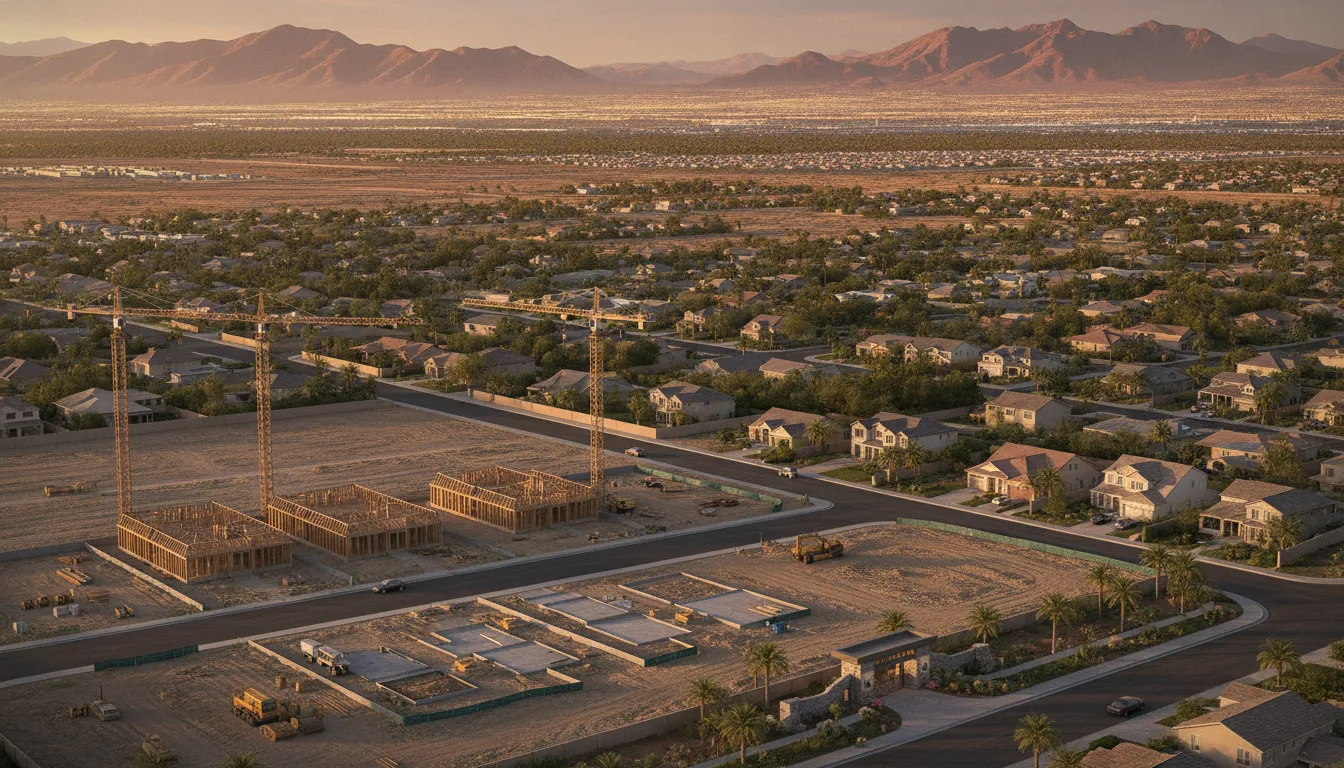
Land is one of the most important long-term constraints in Southern Nevada real estate. Much of Nevada is federally managed, and large areas surrounding the Las Vegas Valley are not available for typical residential development. That limits the traditional pattern of suburban growth spreading outward in every direction.
As a result, much of the valley's future housing growth is expected to come from remaining development parcels, planned communities, redevelopment opportunities, and infill locations. Land released through the Southern Nevada Public Land Management Act has helped support development, but the supply of practical residential land is finite. Some remaining parcels may face topography, infrastructure, environmental, or marketability constraints.
What Limited Land Means for Homebuyers
Limited land does not guarantee price appreciation. Housing values can still change with interest rates, employment conditions, inventory, construction costs, and buyer demand. However, constrained land can make certain established locations more difficult to replace, especially communities close to Red Rock Canyon, central Henderson, mature Summerlin villages, and other developed parts of the valley.
Buyers should distinguish between land that is technically undeveloped and land that is realistically ready for homes. A parcel may require roads, utilities, grading, approvals, water planning, and substantial construction time before it becomes available housing inventory.
Where Major Development Activity Is Concentrated
Several areas are frequently discussed as important parts of the valley's future residential growth:
Summerlin West: Continued village development, new homes, higher-elevation locations, and access to Red Rock Canyon are central factors in this area's appeal.
Southern Henderson and Inspirada: This portion of the valley has continued to attract buyers seeking planned communities, parks, newer homes, and access to the Henderson employment base and the 215 Beltway.
Northwest Las Vegas: New development around the northwest and Sky Summit area may expand housing choices over time, though construction schedules and final community features can change.
Blue Diamond Hill: A large proposed residential project near Red Rock Canyon has the potential to become a major long-term addition to the valley's housing supply. Timing, approvals, infrastructure, and final development details should be confirmed as plans progress.
Areas such as Kyle Canyon may remain part of long-range planning discussions, but long development horizons make them less influential on current inventory than communities already under construction. Pahrump is also a distinct market in Nye County, outside the Las Vegas metropolitan area and subject to different development conditions.
Relocation Demand and Cash Buyers Are Changing Competition
The Las Vegas Valley has long attracted relocation buyers looking for warm winters, access to services, and Nevada's tax structure. That demand shows up in Henderson, Summerlin, Lake Las Vegas, Spring Valley, Paradise, and North Las Vegas, where housing options range from established neighborhoods to new construction and age-qualified communities.
Many repeat buyers bring accumulated equity from a previous home, while first-time buyers often need financing. That mix can increase competition for homes with practical features, particularly single-story layouts and properties with lower maintenance requirements.
Why Single-Story Homes Often Draw Stronger Attention
Single-story homes appeal to a wide range of purchasers who want fewer stairs, easier day-to-day circulation, and long-term flexibility. In Southern Nevada, these layouts can be especially sought after in newer communities where buyers also value modern energy features, desert landscaping, covered patios, and manageable lot sizes.
When inventory is limited, desirable single-story homes may receive offers from both financed and cash buyers. A financed buyer is not automatically at a disadvantage, but financing preparation and offer terms can affect how competitive an offer appears.
Age-Qualified Communities Require Careful Review
Southern Nevada includes several age-qualified communities, including Sun City Summerlin and other Del Webb developments. These neighborhoods may offer golf, recreation facilities, clubs, and a maintenance-oriented lifestyle. Eligibility rules vary by community and governing documents.
Some age-qualified communities may allow a limited percentage of residents below the standard minimum age, while others may apply stricter requirements. Review the current HOA documents, occupancy rules, resale restrictions, fees, and amenities before making an offer.
Nevada Tax Considerations Support Relocation Interest
Nevada has no individual state income tax. For some relocating households, that can be a meaningful part of a broader financial comparison, particularly for those receiving retirement distributions or moving from states with higher income tax rates.
Nevada also does not impose an estate tax or inheritance tax at the state level. These factors can be relevant, but a move should not be based on tax treatment alone. Housing costs, insurance, healthcare access, HOA fees, travel needs, utility expenses, and the buyer's overall residency situation all deserve consideration.
Tax rules can change and individual circumstances differ. Buyers considering a move for tax reasons should obtain current guidance from a qualified tax professional before establishing residency or making a purchase decision.
California Is Important, but Las Vegas Migration Has Broadened
California remains an important source of relocation interest for the Las Vegas Valley. Buyers moving from Los Angeles, Orange County, San Diego, the Bay Area, and inland Southern California may have substantial equity from a prior property. That equity can make a Las Vegas purchase more flexible, particularly when a buyer sells before purchasing or uses a large down payment.
Relocation interest is not limited to California. Buyers also arrive from Arizona, Washington, Oregon, and other states for employment, retirement, family connections, cost comparisons, and access to Las Vegas amenities. Harry Reid International Airport, major medical facilities, entertainment, dining, and outdoor destinations such as Red Rock Canyon and Lake Mead can all influence relocation decisions.
However, a broad migration trend does not mean every neighborhood will perform the same way. A buyer relocating from another state should evaluate the specific community, not assume that metro-wide demand will solve an unsuitable commute, an expensive HOA structure, or an impractical home layout. For a deeper look at what daily life here involves, see Is Las Vegas a Good Place to Live? Who Thrives in Southern Nevada.
The Las Vegas Value Gap Has Narrowed
For many years, Las Vegas was commonly viewed as a place where buyers could sell a higher-priced coastal home and purchase considerably more square footage for less. That comparison can still be favorable in many cases, especially against some coastal California markets. However, the difference is generally not as dramatic as it was when Las Vegas home prices were substantially lower.
Across Clark County, the median list price of homes for sale right now is about $469,900. Housing costs have risen significantly since the mid-2010s, and the cost of owning a home includes more than the purchase price. Relocation buyers should calculate the full monthly and annual cost of ownership.
Costs to Compare Before Buying in Las Vegas or Henderson
Mortgage payment, if financing is used
Property taxes
HOA or master-planned community fees
Homeowners insurance
Utility costs, especially summer air-conditioning use
Pool maintenance, if applicable
Landscape and irrigation maintenance
Commute costs and travel frequency
Future maintenance for roofing, HVAC systems, windows, and exterior finishes
Southern Nevada summers make air-conditioning performance a material ownership consideration. Ask about the age and condition of HVAC equipment, insulation, windows, sun exposure, shade structures, pool equipment, and utility history when available. Desert landscaping can reduce some maintenance needs, but irrigation systems still require inspection and periodic repair.
New Master-Planned Communities Can Affect Nearby Housing Choices
Large planned developments can reshape the market around them. New roads, retail space, parks, schools, trails, recreation facilities, and housing options may increase attention on an area. At the same time, construction can take years and may bring traffic, dust, road changes, and uncertainty about final buildout.
Projects discussed in the Las Vegas Valley include development in Summerlin West, the northwest Sky Summit area, the southern Henderson corridor, and future plans near Blue Diamond Hill. Builders associated with active or anticipated development can change over time, as can lot releases, product types, incentives, and completion schedules.
Questions to Ask Before Buying Near a Future Project
What is currently approved, planned, or only proposed?
Where will future roads, commercial areas, schools, parks, and construction access be located?
Will the home back to open land that may later become construction or another residential phase?
What utilities and infrastructure are already in place?
What HOA or master association costs apply now, and what services do they cover?
How long is the anticipated construction period for nearby phases?
Are there comparable resale homes nearby that provide a useful pricing benchmark?
Treat future development as a consideration, not a certainty. Planned projects can create opportunity, but no buyer should assume a future retail center, park, view corridor, or appreciation outcome until the relevant plans and approvals are confirmed.
How Key Las Vegas Submarkets Differ
Henderson
Henderson offers a broad range of established and newer housing options, from townhomes and tract homes to luxury hillside properties. Communities such as Green Valley, Inspirada, Anthem, MacDonald Highlands, Ascaya, and Lake Las Vegas provide different combinations of housing age, lot size, HOA structure, elevation, and access to services.
Henderson buyers often compare proximity to the 215 Beltway, Interstate 11, Harry Reid International Airport, healthcare, shopping, and employment centers. Higher-elevation or luxury communities may command a premium for views, architecture, privacy features, and lot positioning.
Summerlin and Summerlin West
Summerlin is a large master-planned area on the western side of the valley. It includes established villages, golf-oriented areas, age-qualified housing, condominiums, townhomes, and luxury properties. Summerlin West continues to be a focal point for new construction and higher-elevation development near the Red Rock Canyon area.
Compare resale and new construction carefully. A newer home may offer current design preferences and builder warranties, while an established resale home may have mature landscaping, completed infrastructure, and a more predictable surrounding environment.
Northwest Las Vegas
The northwest includes a mixture of established neighborhoods, newer communities, and future growth areas. Access to U.S. Route 95 and the 215 Beltway can be a key factor for commuters. Buyers considering northwest development should evaluate current road access, nearby services, construction activity, and the time required for planned amenities to be completed.
Lake Las Vegas
Lake Las Vegas provides a distinct resort-oriented setting east of Henderson, with a mix of condominiums, townhomes, detached homes, and higher-priced properties. Its draw is lake-adjacent scenery, golf, and a more contained development pattern.
Because the location and community structure differ from central Henderson or Summerlin, consider travel time to work, shopping, medical services, the airport, and regular destinations. HOA and master association fees should also be reviewed in detail.
Luxury Communities
Luxury inventory in communities such as MacDonald Highlands and Ascaya is influenced by different factors than typical resale homes. Architectural design, view quality, lot location, guard-gated access, finishes, and custom construction can create substantial variation between two homes in the same community.
High-value sales can signal demand for a particular segment, but they should not be used to estimate the value of every nearby property. A careful comparison of lot characteristics, build quality, home condition, and current competition is essential. Buyers exploring this segment can browse luxury homes in Las Vegas to get a sense of current inventory and price ranges.
How Financed Buyers Can Compete With Cash Offers
Cash offers can be attractive to sellers because they may reduce financing uncertainty. Still, cash does not always win. A financed offer can remain competitive when the buyer has strong preparation and terms that align with the seller's priorities.
Practical Offer Preparation Checklist
Obtain a current, fully reviewed loan preapproval rather than relying on a basic prequalification.
Understand the maximum comfortable payment before touring homes.
Keep documentation available for the lender so financing conditions can be handled promptly.
Review inspection, appraisal, financing, and closing timelines before submitting an offer.
Consider the property's condition and likely appraisal support, especially for unique homes.
Provide a clear offer with minimal avoidable complications.
Remain focused on the total cost and terms rather than competing only on price.
Do not waive important protections merely to imitate a cash offer. The right terms depend on the property, financing type, condition, local competition, and your risk tolerance.
Common Mistakes When Researching a Move to Las Vegas
Using Only National or Citywide Housing Headlines
National reports can provide context, but they do not explain conditions in a specific Henderson village, a Summerlin resale neighborhood, or a new construction release. Compare homes at the community and price-range level.
Assuming Every New Construction Home Is a Better Deal
Builder incentives, design-center selections, lot premiums, HOA fees, closing costs, and timelines can change the true cost of a new home. A resale property may offer completed landscaping, appliances, window coverings, and upgrades that are not included in a base new-build price.
Overlooking the Impact of Heat and Sun Exposure
A home's orientation, shade, window quality, insulation, air-conditioning capacity, and outdoor layout matter in the Las Vegas climate. Inspect these features as carefully as kitchen finishes or flooring.
Assuming Undeveloped Land Will Remain Open Indefinitely
Vacant land can be appealing, but investigate ownership, zoning, planned roads, and development proposals. Open views and undeveloped parcels can change over time.
Making a Tax-Driven Move Without Reviewing the Full Financial Picture
Nevada's lack of individual state income tax can be significant, but the complete cost of homeownership still matters. The best relocation decision accounts for housing, lifestyle, healthcare, travel, maintenance, and long-term needs.
A Smarter Process for Out-of-State Las Vegas Buyers
Set a full ownership budget. Include down payment, monthly payment, HOA fees, insurance, utilities, maintenance, and moving costs.
Choose priorities before choosing a community. Examples include commute time, single-story living, a gated setting, low-maintenance property features, views, or walkability to services.
Compare at least two or three submarkets. A buyer considering Henderson may also compare Summerlin, Green Valley, Inspirada, Northwest Las Vegas, or Lake Las Vegas based on the intended lifestyle.
Separate confirmed development from promotional claims. Review maps, community plans, zoning, builder disclosures, and HOA information.
Tour at different times when possible. Traffic patterns, sun exposure, road noise, construction activity, and neighborhood activity can vary substantially by time of day.
Review property-specific costs. Pool equipment, HVAC age, roof condition, landscaping, solar agreements, and HOA rules can affect ownership costs.
Make decisions based on current affordability and long-term fit. Future price growth, mortgage-rate changes, and development outcomes cannot be guaranteed.
Key Takeaway
The Las Vegas housing market is being shaped by more than short-term inventory and price movements. Land constraints, continued relocation interest, cash purchasing power, and large-scale development plans are creating very different conditions across the valley.
For buyers moving to Las Vegas, Henderson, Summerlin, or nearby Southern Nevada communities, the strongest approach is patient and local. A well-chosen home should fit your budget, daily routine, property preferences, and long-term ownership needs, regardless of whether the broader market is gaining or losing momentum.
Frequently asked questions
Is the Las Vegas housing market cooling down right now?
Why is buildable land so limited in the Las Vegas Valley?
Are cash buyers common in Henderson and Summerlin?
What should buyers consider before purchasing new construction in Las Vegas?
Does Nevada's lack of state income tax make Las Vegas less expensive?
Which Las Vegas areas have major future development planned?
Market figures in this article update automatically. Based on information from the Las Vegas REALTORS® Multiple Listing Service for the period September 1, 2026 through September 30, 2026.
Homes for sale in Las Vegas, Nevada
Thinking about a move to Las Vegas?
Browse every home for sale across the valley — Summerlin, Henderson, 55+ communities, high-rise condos, new construction and more — updated every few minutes. Or talk to a local agent who knows the neighborhoods.
Las Vegas, Nevada housing market
A quick read on what homes are doing in Las Vegas right now — pulled live from the MLS.
Based on information from the Las Vegas REALTORS® Multiple Listing Service for the period September 1, 2026 through September 30, 2026.
Keep reading
More from the blog
What Zillow Housing Data Means for Las Vegas Buyers and Sellers

Las Vegas Housing Market: National Rankings vs. Local Sales Reality
Is Las Vegas a Good Place to Live? Climate, Costs & Lifestyle