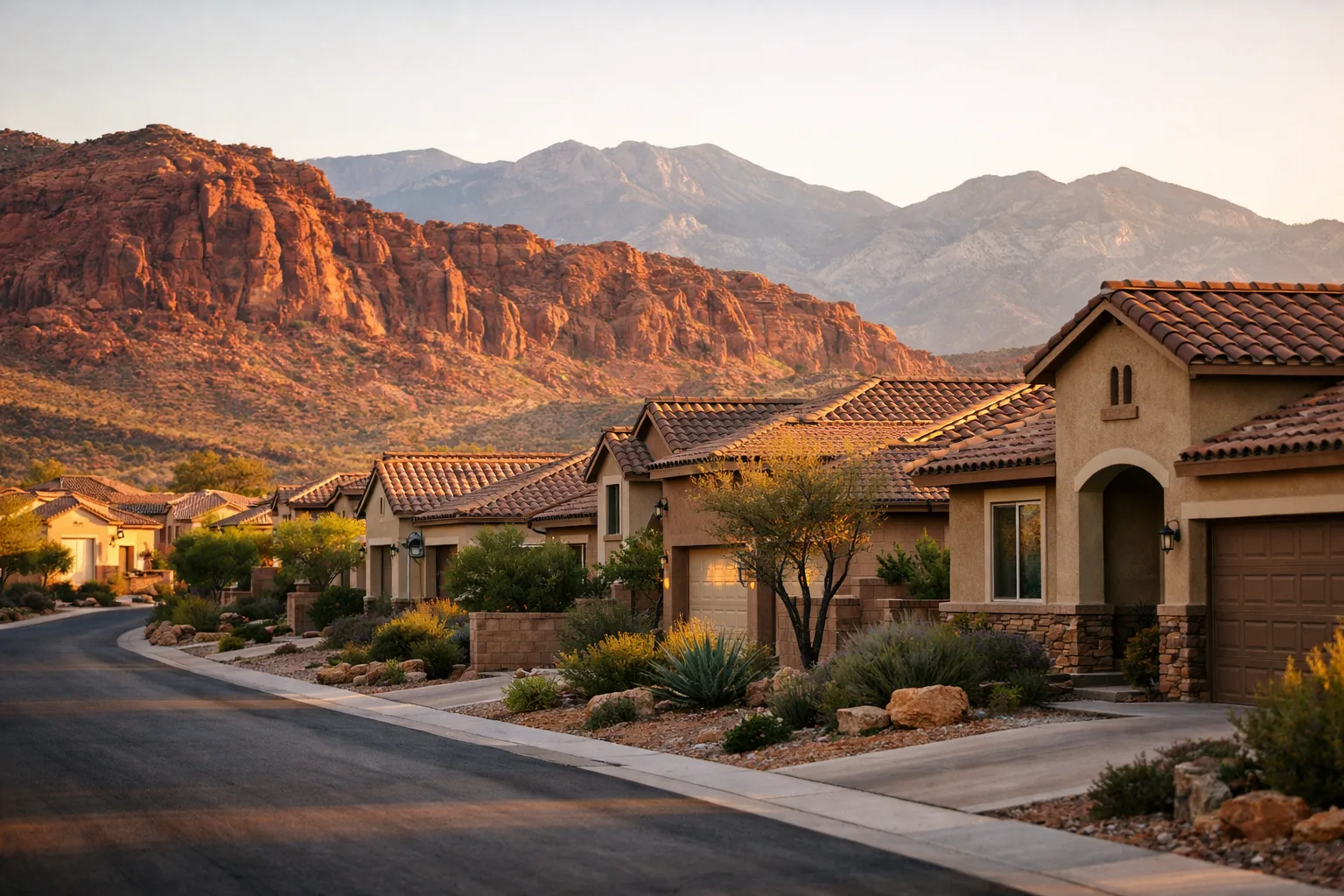
Moving From California to Las Vegas: What Changes Beyond the Home Price
Moving from California to Las Vegas can stretch a housing budget and remove Nevada income tax from the picture, but the real savings depend on the home, the neighborhood and total ownership costs. We cover taxes, summer heat, commutes, neighborhoods and a relocation checklist.
Moving from California to Las Vegas can stretch a housing budget further, put you in a state with no individual income tax, and keep California within reach by road or air. Whether it actually saves money depends on the home you leave, the Las Vegas property you choose, and ongoing costs such as cooling, HOA dues, insurance and commuting. We recommend comparing one specific home and neighborhood against your real monthly budget instead of comparing the two states in general.
Key takeaways
- Compare total ownership cost. Mortgage, property taxes, insurance, HOA dues, cooling and upkeep matter more than the purchase price alone.
- Nevada has no individual state income tax, but California can still tax income with a California source, and the timing of your residency change matters.
- The valley is not one place. Summerlin, Henderson, North Las Vegas and the southwest valley each suit different routines and routes.
- Summer heat is a housing issue. It affects your schedule, your utility bills and what you should inspect before buying.
- Test before you commit. Drive your real routes, visit in different conditions, and consider renting first.
Is Moving From California to Las Vegas Worth It?
For many households it can be, because several advantages work together. Housing purchasing power may improve, remote work may make a move possible without a job change, and proximity to California keeps return trips manageable. Las Vegas also pairs suburban neighborhoods with restaurants, entertainment, professional sports, hiking and golf.
- Housing choices: Buyers leaving expensive California markets may find more space or different property features within their budget.
- State income taxes: Nevada does not impose an individual state income tax, although California tax obligations require a separate review.
- Work flexibility: Remote employment and location-independent businesses can reduce the need to remain near a California office.
- Daily convenience: Some relocation buyers may shorten their commute while retaining access to big-city amenities.
- California access: Road connections and flights make Las Vegas a practical option for households maintaining California ties.
These advantages are not universal. A household leaving coastal California may face a substantial climate adjustment, and someone coming from a smaller California town may not find Las Vegas less expensive in every category. Our guide on whether Las Vegas is a good place to live goes deeper on climate, costs and layout.
For a sense of the current market, the median home in Las Vegas recently closed at $430,823 and spent a median of 28 days on the market. Our monthly Las Vegas housing market report tracks those figures as they change.
What causes relocation regret?
Regret often begins with a mismatch between expectations and daily experience. A buyer may love a home's space but dislike the drive to regular activities. Another may value proximity to Red Rock Canyon but find that a different neighborhood offers a more practical mix of layout, price and convenience.
The main issues worth testing before a move include:
- Climate expectations: Outdoor access does not mean comfortable conditions at every hour throughout the year.
- Budget assumptions: Lower housing costs do not mean every other expense will fall.
- Location fit: Henderson, Summerlin and the individual neighborhoods within them are not interchangeable.
- Purchase timing: An unfamiliar market can make a rushed purchase harder to evaluate.
- Social routines: Working remotely and moving away from established connections require deliberate opportunities to meet people.
- Lifestyle trade-offs: Mountains, desert trails and lake recreation offer different experiences from California's coast.
None of these issues makes relocation a poor choice. They mark the areas where firsthand research is more useful than broad claims about affordability or quality of life.
Does California migration drive Las Vegas prices?
Incoming households can add to housing demand and support new construction, retail activity and services. Existing homeowners may benefit when values rise, while buyers and renters may face affordability pressure. That is why growth is welcomed and criticized at the same time.
California migration alone does not explain every change in Las Vegas prices, and it is not a dependable forecast for appreciation. Claims that you must buy immediately to get ahead of growth are no substitute for evaluating price, financing, condition and ownership costs. Likewise, people leaving a California city do not automatically make its remaining housing affordable, so base your decision on current comparable properties rather than a migration narrative.
Planned high-speed rail is one more factor some California buyers raise, and we cover it in our look at Brightline West and Las Vegas housing demand.
If you plan to keep a California rental or buy a Nevada investment property, run a separate operating analysis. Maintenance, vacancy, management, insurance, HOA restrictions and current rental rules all matter, and neither state should be assumed to be uniformly favorable to landlords.
What Does Living in Las Vegas Cost Compared With California?
Housing is often the largest financial reason to move. A California homeowner may be able to buy a larger or newer home, or change housing styles, without matching the price of a comparable property in an expensive California market. The median list price across Clark County is currently $469,000, but one countywide figure says little about the specific home you would buy.
The useful comparison is total ownership cost. Mortgage payments, property taxes, insurance, HOA dues, cooling, landscaping and maintenance belong in the same budget. For a household leaving the Bay Area, a larger living area, a dedicated office or a two-car garage can matter as much as the purchase price, but your savings should not be treated as a universal California-to-Nevada result. Compare actual candidate properties and actual household spending rather than statewide averages.
For a broader list of budget surprises, see our guide to costly mistakes to avoid before moving to Las Vegas.
| Budget category | What a relocation buyer should compare |
|---|---|
| Housing payment | The current mortgage obligation against financing terms for the replacement home, not just the difference in sale prices. |
| Taxes and insurance | Property-specific estimates and insurance quotes rather than costs carried over from the California home. |
| HOA expenses | Recurring dues, included services, community amenities, and restrictions affecting planned property use. |
| Utilities | Summer cooling needs, home size, insulation, window exposure, and available utility history. |
| Maintenance | Air-conditioning equipment, roofing, irrigation, landscaping, and any pool or outdoor features. |
| Transportation | Work trips, airport access, routine driving, and the frequency of return visits to California. |
| Relocation expenses | Moving, temporary housing, overlapping ownership costs, and immediate repairs or furnishings. |
More space can come with more upkeep
A larger home may mean better purchasing power, but extra square footage also means more space to cool and maintain. If you are drawn to homes with pools in Las Vegas, treat the pool as a lifestyle choice with recurring work and expense, not a free upgrade.
In master-planned communities, read the HOA documents before you buy. The bylaws and CC&Rs of the actual Nevada community, not a general explanation, determine its restrictions, dues and owner responsibilities.
Property taxes need a property-specific review
A former California tax bill does not tell you what a Nevada property will cost, so review the actual parcel information and the tax treatment that applies after purchase. As the Clark County tax abatement page explains, Nevada caps the annual increase in the tax bill on an owner's primary residence at 3%, only one Nevada property can carry that designation, and other property types are capped at up to 8%.
That cap limits increases; it does not set your starting bill. Our walkthrough of tax savings after homeownership costs shows how property tax, special assessments and vehicle fees fit together.
Insurance and utilities may offset some savings
Housing savings can coexist with higher costs elsewhere. Get address-specific quotes for homeowners and automobile insurance rather than assuming either will fall. Grocery savings can also be uneven, with noticeable differences at some stores and little difference on other purchases.
Summer electricity deserves its own budget review. A household that has not yet lived through a full Las Vegas summer has only a partial picture of annual utility spending, even if early bills look favorable.
Assumptions to avoid when comparing costs
These are the assumptions that most often skew a California-to-Nevada budget.
| Expense | What the household should compare | Assumption to avoid |
|---|---|---|
| Housing payment | Purchase price, financing terms, down payment, and usable space | A lower asking price automatically produces a comfortable monthly payment |
| Property taxes | The specific property’s tax record and applicable treatment after purchase | A California tax calculation transfers directly to Nevada |
| HOA expenses | Dues, included services, maintenance responsibilities, and governing documents | A townhome’s advertised price represents its complete ownership cost |
| Insurance | Address-specific homeowners and automobile insurance quotes | Both policies will become less expensive after relocation |
| Utilities | Available usage history, home size, and summer cooling needs | A mild-weather electricity bill represents the annual budget |
| Transportation | Fuel spending and the frequency of trips to work, recreation, and errands | Less expensive fuel necessarily means lower total driving costs |
| Groceries and leisure | The household’s usual shopping basket and realistic activity spending | Every purchase will cost less than it did in California |
How Does Nevada's No-Income-Tax Rule Affect a California Move?
Nevada's lack of an individual state income tax is a meaningful consideration for employees, business owners and other income earners. A move does not produce the same savings for every household, though. An estimate based only on annual salary can overlook filing status, deductions, residency timing and income sources, and it does not resolve obligations tied to a partial year in California or California-source income.
Nevada residency and California tax treatment are separate questions. Anyone keeping California employment, business activity, rental property or other connections should review how those facts affect continuing obligations. The California Franchise Tax Board is the authoritative starting point for California residency and income-tax guidance.
The FTB's Publication 1100 explains how California computes tax for people who move out of the state, using California-source income for the nonresident period and all income for the resident period. Its residency guidelines in Publication 1031 add that California residents are taxed on all income from any source, while nonresidents are taxed only on California-source income, including pay for services performed in California. A tax professional can apply those rules to your dates and income.
Remote workers should confirm the employment arrangement
Remote work can make a California-to-Las Vegas move possible without changing employers. Before building a purchase budget around that arrangement, confirm that Nevada-based work is permitted and whether compensation, payroll handling or required office visits will change.
- Does the employer allow permanent work from Nevada?
- Will compensation remain the same after relocation?
- How often will in-person attendance in California be required?
- Will travel costs fall on the employee or employer?
- Does the prospective home provide a workable office layout and suitable internet service?
An occasional California office visit may be manageable. Frequent travel can erode both the financial savings and the time gained from relocating.
Business owners should compare total compliance costs
Nevada's tax structure can attract entrepreneurs, small-business owners and content creators. The absence of an individual state income tax and a franchise tax is part of that appeal, but operating in Nevada is not free of taxes, licenses, fees or reporting requirements.
A useful comparison includes entity maintenance, state and local licensing, payroll responsibilities and any obligations remaining in California. The Nevada Department of Taxation provides official information on applicable state taxes, so you do not have to rely on a blanket claim that Nevada businesses pay none. For example, the Nevada Commerce Tax statute applies only to business entities with Nevada gross revenue above $4,000,000 a year, and no return is required at or below that level, but other business taxes can still apply.
Which Las Vegas Valley Neighborhood Fits Your Daily Routine?
Much of daily life here takes place in suburban neighborhoods across Las Vegas, Henderson, North Las Vegas and unincorporated Clark County, not on the Strip. Henderson is a separate city, not a neighborhood within Las Vegas. The right starting point is a list of your frequent destinations: work, gym, groceries, healthcare, recreation and airport trips.
Current Las Vegas real estate listings help turn a broad idea into a property-by-property comparison. Our overview of the best Las Vegas suburbs for lifestyle and value compares several areas side by side.
Summerlin and the west side
Summerlin is a master-planned setting on the west side of the valley, with access to Red Rock Canyon recreation and Downtown Summerlin's shops and restaurants. Browse Summerlin homes for sale with HOA obligations and the route to your regular destinations in mind. Some properties may offer mountain scenery or distant Strip views, but those features need to be verified for the individual home.
The practical question is how much that setting matters relative to price, layout and immediate surroundings. Judge traffic and activity on the actual street rather than from Summerlin's general reputation.
Henderson: Green Valley, Inspirada and Anthem
Henderson includes several distinct communities, so compare neighborhoods, floor plans, recurring costs and location relative to work and recreation. Homes there recently closed at a median of $505,000, at about 98.1% of list price.
Green Valley can be a useful base for establishing shopping, exercise and dining routines, and you can browse Green Valley homes for sale to see what is available. That familiarity does not oblige you to buy there; you can keep visiting favorite businesses while choosing a home elsewhere that better meets your space or budget priorities.
If newer housing is part of your search, look at Inspirada homes for sale. One property may offer a more appealing mix of square footage, garage space, layout and price than a home you are considering in Summerlin, but that is a property comparison, not proof that all Henderson homes offer better value. Anthem is another Henderson community worth adding to the list.
North Las Vegas and the southwest valley
North Las Vegas includes master-planned communities and new-construction options. The southwest valley includes areas such as Southern Highlands and Mountain's Edge, where 215 Beltway access is relevant to many searches. In either area, actual listings and driving routes give a better comparison than broad assumptions about value or convenience.
Strip-adjacent and downtown housing
Condominium living is an alternative to suburban ownership. Compare building expenses, parking arrangements, property rules and the daily environment of high-rise condos in Las Vegas against detached-home options.
Other areas can reveal overlooked options
Skye Canyon on the northwest side is one example, and Centennial Hills and Seven Hills may also broaden a search beyond your original shortlist. Exploring an unfamiliar area can clarify your preferences even if no home there becomes the final choice.
Neighborhood research should focus on observable features and practical needs. Our checklist on what to evaluate before moving into a neighborhood covers general considerations, while Southern Nevada details still need a local review.
How Does Summer Heat Change Daily Life and Home Choice?
Las Vegas summers can be intensely hot, especially in July and August. Dry air feels different from humidity, but low humidity does not remove the practical effects of extreme heat. Triple-digit temperatures change the timing of walks, workouts, pet outings and errands, and an air-conditioned home, car and indoor destination make routines workable without making outdoor heat harmless.
Morning and evening activity is often more practical than afternoon activity, but check conditions rather than assuming it is comfortable after sunset. Shade, covered patios and misters improve comfort without eliminating heat-related risks. Early enthusiasm during a mild arrival period does not show how you will handle a whole summer.
For a buyer, the climate makes cooling performance and sun exposure a core part of property evaluation. A home that looks great in mild weather should also be assessed for summer use.
- Air conditioning: Review equipment condition, service history and inspection findings.
- Windows and insulation: Examine features that affect indoor comfort and cooling demand.
- Afternoon exposure: Consider how direct sun affects main living spaces and outdoor areas.
- Shade: Evaluate covered patios and other usable shaded spaces.
- Landscaping: Review irrigation condition, maintenance needs and water-conscious design.
- Utility history: Request available bills, recognizing that occupancy and thermostat settings affect usage.
Some buyers also look at solar homes in Las Vegas to manage cooling costs, though the terms of any solar system need careful review.
Outdoor recreation remains a major part of the region
Southern Nevada offers more outdoor variety than the Strip-centered image suggests:
- Red Rock Canyon: Hiking, climbing and desert scenery, with activities planned around conditions.
- Lake Mead: Water recreation, including kayaking and paddleboarding.
- Mount Charleston: Higher-elevation recreation and a cooler setting than the valley during summer.
- Lake Las Vegas: Waterfront activities and a different setting for a local getaway.
- Local recreation facilities: Golf, pickleball and fitness activities that can become regular routines.
These options do not reproduce California's coastal lifestyle. If you use the beach often, treat losing convenient ocean access as a real trade-off rather than assuming other recreation will replace it.
How Do Commutes, Remote Work and Daily Life Compare?
Test your commute before choosing a home
A shorter commute can improve daily life, but Las Vegas does not guarantee one. The home's location, your employment destination, your schedule and traffic conditions determine the result. Evaluate routes involving Interstate 15, the 215 Beltway, Interstate 11 and U.S. Route 95 for your actual trip rather than how they look on a map.
Hypothetical example: If a relocation reduces each leg of a commute from 60 minutes to 30 minutes, the household gains one hour per workday, or five hours a week across five workdays. The math shows the value of a shorter trip, but it is not an estimate of typical Las Vegas commute savings.
Harry Reid International Airport adds a practical advantage for households maintaining California connections. Check available routes, schedules and fares against how often you expect to travel, and remember that a convenient flight does not eliminate ground transportation or airport processing time.
Remote work needs a suitable home and outside connections
A larger home can improve remote work when it provides a dedicated office rather than a desk competing with living space. Room separation, usable daylight and a layout that supports focused work deserve attention during tours. In Southern Nevada, weigh brightness against afternoon sun exposure and cooling comfort, and confirm internet service and your employer's permission to work from Nevada before the move.
Working remotely reduces commuting, but it does not create a social network. A practical plan includes recurring activities outside the home, such as fitness classes, business networking, workshops, neighborhood events or recreation groups. Those settings offer repeated contact without guaranteeing friendships or business results, so aim for consistent participation rather than attending every event.
Separate local life from the Strip
The Strip is only one part of life in the valley. Residents can choose occasional concerts and restaurants there while keeping most daily routines elsewhere, and local casinos offer dining and entertainment outside the tourist corridor. Some venues offer local discounts, but check eligibility and availability instead of building them into the budget.
How newcomers from California will be received cannot be predicted in advance. Regular participation in shared-interest activities is a more practical approach than expecting either automatic acceptance or hostility.
How Should You Plan a Scouting Trip and a Transition?
With 7,549 homes for sale in Las Vegas right now, a relocation visit works best when it includes more than home tours. Grocery shopping, a workout, a meal and a drive between likely destinations show whether a location supports your intended routine.
- Allow time beyond property appointments. An extra day or two leaves room for independent neighborhood exploration.
- Drive the likely recurring routes. Include 215 Beltway connections where relevant, along with the local streets used for errands.
- Visit at different times. A single midday visit cannot show a street's typical activity or whether an evening routine is practical.
- Keep home-tour batches manageable. Smaller groups of appointments make layouts and locations easier to distinguish.
- Record observations afterward. Notes on noise, light, space, parking and travel separate a strong first impression from a durable preference.
- Compare the finalists again. A second visit tests whether the same advantages remain persuasive.
You can add weekend open houses in the Las Vegas Valley to a visit as an easy way to see several layouts. No valley-wide travel-time promise should substitute for route testing, because starting point, destination, time of day and traffic all affect convenience.
Consider renting before buying
A temporary rental reduces the pressure to choose a permanent home before you understand the area. It gives you time to compare neighborhoods, run ordinary errands and learn which destinations become part of your weekly routine.
A transition rental must work financially and contractually, not just emotionally. If you expect to buy before the lease ends, review the lease term, early termination provisions and any overlap between rent and ownership expenses. An intention to leave early does not remove lease obligations. When renting first is not feasible, a more thorough scouting trip and a clear property checklist become especially valuable.
California-to-Las Vegas Relocation Checklist
Before committing to a Las Vegas Valley home, work through these steps:
- Set a complete ownership budget. Include financing, taxes, insurance, HOA dues, utilities, maintenance and relocation expenses, without assuming every cost will fall.
- Confirm income continuity. Establish remote-work permission or business operating arrangements before relying on existing earnings.
- Review tax exposure. Evaluate residency timing and income connected to California rather than assuming all California obligations end.
- Check property-specific costs. Review the property's tax information, HOA documents and insurance quotes.
- Map routine destinations. Test work routes, shopping, recreation, healthcare and California travel instead of relying on broad travel-time claims.
- Compare actual properties. Look at more than one neighborhood and property type, and assess condition, layout, workspace, garage features and cooling equipment.
- Visit in different conditions. Include peak commuting periods and, when practical, summer weather.
- Plan your routines. Build a workable plan for summer schedules and regular social activities, and decide which California lifestyle features you cannot replace.
- Plan the transition. Account for sale timing, temporary housing, overlapping costs and the possibility that the two transactions will not line up.
For another budgeting perspective, read our guide to financial mistakes homebuyers should avoid, and then apply it to a specific Nevada property.
The strongest relocation decision combines financial breathing room with a location that supports ordinary life. More space, appealing recreation and no Nevada income tax can make the move worthwhile, but firsthand neighborhood testing and a complete budget are what turn those possibilities into a practical housing choice.
Frequently asked questions
Is it cheaper to live in Las Vegas than in California?
Does moving to Nevada end your California income tax obligations?
Can a California remote worker keep the same job after moving to Las Vegas?
Is moving from California to Las Vegas worth it?
Should you rent before buying a home in Las Vegas?
Is Henderson part of Las Vegas or a separate city?
How much does summer heat change daily life in Las Vegas?
Is Summerlin or Inspirada a better choice for relocation buyers?
Market figures in this article update automatically. Based on information from the Las Vegas REALTORS® Multiple Listing Service for the period September 1, 2026 through October 19, 2026.
Homes for sale in Las Vegas, Nevada
Thinking about a move to Las Vegas?
Browse every home for sale across the valley — Summerlin, Henderson, 55+ communities, high-rise condos, new construction and more — updated every few minutes. Or talk to a local agent who knows the neighborhoods.
Las Vegas, Nevada housing market
A quick read on what homes are doing in Las Vegas right now — pulled live from the MLS.
Based on information from the Las Vegas REALTORS® Multiple Listing Service for the period September 1, 2026 through October 19, 2026.
Keep reading
More from the blog
Living in Skye Canyon: A Northwest Las Vegas Buyer's Guide
North Las Vegas Home With Solar: What to Verify Before Closing

Living in Cadence, Henderson: What to Check Before You Buy